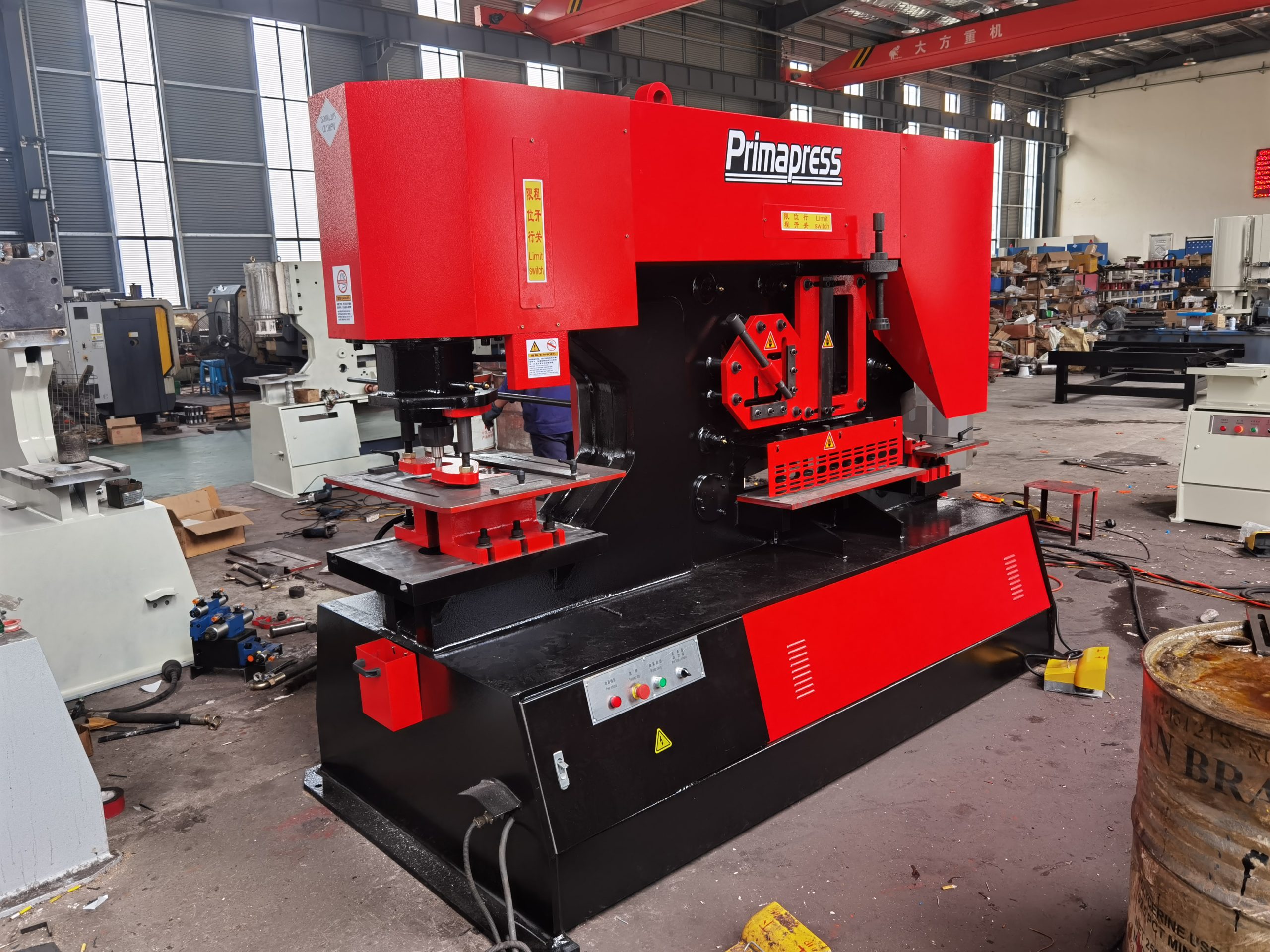
Selecting steel fabrication shop notching equipment goes beyond fitting the machine into the floor space. Data sheet characteristics like notching thickness, blade material, stroke speed, and die arrangement affect what the machine can handle daily and how long it can remain productive before needing major repair.
An ironworker notcher machine shears corner portions from flat plate, angle iron, and structural components to create clean, square-edged notches without heat distortion or subsequent finishing. When incorporated into a combined ironworker, the machine shares hydraulic power with punching and shearing stations, making machine specification related to all stations. When the notching function is a separate unit, its specifications may be assessed against the notching work’s needs.
Either way, knowing what each parameter means and how it affects cutting performance helps fabricators choose the right machine rather than the biggest or cheapest.

Notching Thickness and Material Compatibility
Most purchasers examine the notching thickness rating first, but a single statistic might hide vital details about the machine’s manufacturing performance.
Mild steel, a low-carbon type with yield and shear strengths of 235 to 250 and 290 to 370 MPa, is used to assess the thickness of most ironworker notching machines. This baseline makes machine comparisons easy for mild steel, but it needs tweaking for other materials. Stainless steel, aluminum alloy, and high-strength structural steels have varying shear strengths that affect notching capability compared to mild steel.
The cutting force depends on thickness and notch size, which removes corner dimensions. To cut a 50 mm x 50 mm notch in 10 mm mild steel, the machine must shear 100 mm of total cut length at a depth of 10 mm Adding a 100 mm × 100 mm notch in the same material doubles the shear line to 200 mm, needing twice the cutting effort. Capacity ratings on notching machines include both a maximum thickness and a maximum notch size because the two dimensions determine the force demand, and a machine that handles one combination may not handle another even if the thickness alone falls within the rating.
Instead of relying on the specification sheet’s headline thickness figure, fabricators who regularly cut large notch cuts in structural plate should check the machine’s hydraulic force output (kilonewtons or metric tons) to ensure it matches their notch size and material thickness.
https://www.prima-press.com/wp-content/uploads/2023/08/combined-hydraulic-punching-and-shearing-ironworker-machines-1.jpg
Carbon Steel, Stainless Steel, and Aluminum
The most common materials processed by an Ironworker Notcher Machine—carbon steel, stainless steel, and aluminum—interact with the machine’s parameters differently.
Carbon steel in conventional structural grades may be used for notching capacity ratings without modification. With properly maintained blades, low-carbon grades like S235, A36, and equivalents shear reliably and create clean edges. Medium-carbon and high-strength structural grades like S355, A572 Grade 50, and others have yield strengths of 355 MPa or more, which enhances shear strength correspondingly. A machine rated for 12 mm S235 may handle 9–10 mm S355 at the same notch geometry before reaching hydraulic pressure limit.
Austenitic stainless steels like 304 and 316 need increased shear strength and strain hardening during cutting. In the annealed state, 304 stainless has 50 to 70% greater shear strength than mild steel of equal thickness. As the blade enters the material, the work-hardening process increases resistance. Fabricators cutting stainless steel on a mild steel machine often experience pressure relief activation before the cut is complete, indicating that the material is too thick and notch-gap for the machine. When the same machine cuts stainless steel, many fabrication facilities conservatively reduce the rated mild steel thickness by 40to 50%.
Aluminum alloys have opposing force characteristics. The most often notched aluminum alloys are 5052, 6061, and 3003, which have shear strengths of 95 to 205 MPa depending on alloy and temper. For the same notch shape, an ironworker notching machine rated for mild steel can handle aluminum plate at two to two and a half times the thickness due to its lower shear strength. This capacity headroom makes hydraulic ironworker notchers suitable for aluminum structural work in transportation, maritime, and architectural applications using aluminum frame.
Blade Material and Tooling Design
Shearing occurs when the notching blade touches the workpiece. Materials, geometry, and condition affect edge quality, cutting power, and sharpening or replacement life. Choose and maintain a blade specification suited for the material being notched to improve production quality more than most other operator variables.
Hard and robust tool steel grades are used to make hydraulic ironworker notching blades. In tension, tougher steels withstand wear and keep cutting edge geometry longer, but they are more brittle and chip or shatter under impact or overload. Softer tool steels tolerate greater abuse without breaking but lose their edge quicker, necessitating more regrinding.
Notching blades use HSS and cold-work tool steel grades like D2, H13, and equivalents. D2, having a hardness of 58–62 HRC in hardened and tempered, resists abrasion for high-volume mild steel notching. H13, a hot-work tool steel with somewhat lower hardness but improved toughness, is suitable for interrupted cuts, stainless steel, or higher-strength materials where blade chipping is likely. Some manufacturers provide carbide-tipped blades for specialty applications needing prolonged tool life, however carbide’s increased brittleness restricts its usage to constant material conditions and no impact overload.
Tool Life and Replacement Considerations
In notching applications, blade wear on an Ironworker Notcher Machine causes edge rounding, chipping at the cutting corners, and workpiece cut edge quality degradation. An operator familiar with the machine’s normal cutting behavior can detect blade wear by changes in the sound and feel of the cut, increased pressure needed to complete the same cuts, and visible edge quality deterioration on notched workpieces.
Regrinding the blade restores cutting edge geometry and increases its lifespan. Most notching blades have enough material behind the cutting face to regrind numerous times before reaching the required thickness. A blade’s regrinding cycle varies on the material being cut, the frequency of usage, and the precautions taken to prevent overloading and chipping the edge.
After regrinding, blade clearance must be adjusted to match the material being notched. Mild steel clearance is usually 5%–10% of thickness. Burred edges and cutting force increase with insufficient clearance after regrinding. Excess clearance causes curled or warped edges that violate structural connection quality standards.
Long-term use wears the die block, especially the cutting edges that sustain blade shear. Die wear degrades edge quality like blade wear, and in older machines, the die restricts notching quality. Inspection of the die and blade during planned maintenance prevents a newly reground blade from making unsatisfactory cuts due to die wear.
Stroke Speed and Productivity Impact
The number of notching cycles the machine can accomplish per unit time depends on stroke speed, which is the pace at which the cutting blade moves from retracted to stroke bottom and back. If all other variables are equal, a machine producing 10 cycles per minute generates twice as many notches as one producing 5 cycles per minute in high-volume manufacturing.
Stroke speed depends on pump flow rate and cylinder bore diameter. Pump flow rate increases fluid volume per unit time to the cylinder, moving the piston quicker for the same bore diameter. At comparable pressure, a smaller bore cylinder may cycle quicker on the same pump flow rate because it uses less fluid to complete a stroke length. The result is that lighter notching machines with smaller diameter cylinders and moderate pressures cycle quicker than heavy-duty machines with big bore cylinders and high hydraulic power.
Two-stage hydraulic circuits balance stroke speed and force in many hydraulic ironworkers. In the rapid approach stage, the pump produces strong flow at low pressure to swiftly advance the blade across the air gap between its starting point and the workpiece surface. After the blade meets the material and cutting resistance rises, the circuit switches to high-pressure, lower-flow-rate mode to provide the force required to cut. The blade spends less time going through air and the hydraulic power is reserved for cutting, reducing cycle time.
How Stroke Length Affects Accuracy
The capacity and notch accuracy of an Ironworker Notcher Machine depend on stroke length, the blade’s distance from retraction to the cut.
A stroke length comfortably greater than the material thickness ensures the blade cuts and clears the die aperture before retracting the slug. Incomplete slug clearing leaves partly sheared material that must be manually removed and may harm the blade or die next cycle. Slug clearance is seldom an issue while working within the machine’s stated capacity since most ironworker notching stations have stroke lengths that offer acceptable clearance below the maximum rated material thickness.
The blade’s bottom position repeatability affects stroke length and notching accuracy. The depth of cut varies across cycles if pressure fluctuation, fluid temperature variations impacting viscosity, or seal wear causing internal leaks cause the hydraulic stroke to terminate differently. This difference is within tolerance for most structural notching applications. A machine with constant stroke end-point control—mechanical stops, electronic position monitoring, or both—produces more accurate notch geometry for precision manufacturing when notch depth must match weld groove dimensions.
The blade holder’s mechanical stops let the operator change the notch depth without affecting the hydraulic stroke. Instead of traveling the whole cylinder stroke, the blade goes to the stop position, offering the user direct control over notch depth without hydraulic pressure. This adjustability capability is important for notching to a depth different from the complete material thickness, which is required in certain weld joint preparation applications to produce a backing condition for the weld.
Conclusion
An ironworker notcher machine’s thickness capacity, material compatibility, blade grade, tooling design, stroke speed, and stroke length affect its production performance. Fabricators may choose equipment that suits their material range, notch shape needs, and production volume by understanding how these characteristics interact.